With the help of the internet, I set out last week to construct my second piece of shape wear: a Spanish Farthingale. I found it difficult to discern proper dimensions because of 1. the dearth of full length paintings of women during this period (circa 1558) and 2. the fact that I am approximately a full 8 inches taller than the average Elizabethan woman. The practicalities of modern theatre also took their toll: at 5'10" there is a good chance that I'll be the tallest women in a given scene (I often tower over men, too) and I don't want my already large presence + voluminous skirt to completely over-power any tableau that I join. So my goal was be as historically accurate as possible while maintaining proper proportions and trying not to overwhelm everything around me. Here we go!
During my design process, I've been been taking inspiration from this portrait of Bess by Steven Van Der Meulen. Called the "Hampden Portrait," it is thought to be the first full-length portrait of the Queen, painted in 1563. This is just the period I'm looking to re-create, so it's a great resource.
My trim placement and partlet design are also influenced by this painting
What we've got here is an exaggerated trumpet shape, which (unlike most iterations of the Spanish Farthingale) appears to be flared at the bottom. Liz is also probably wearing a modest bum-roll to get that almost horizontal lift of the skirts around her waist. I suspect that the flare shape is not actually from her support garments, but from the heavy weight of her voluminous skirts doing an elegant sweep- farthingales at the time seemed to end several inches above the ground so that the wearer could walk comfortably, and the Queen's skirt is widest right where it hits the floor.
To begin, I checked out these instructions from the Elizabethan Costuming Page: http://www.elizabethancostume.net/farthingale/period.html. Those are based on Juan Alcega's description of how to make a farthingale, which (rock star costume historian) Janet Arnold also studies in her book series.
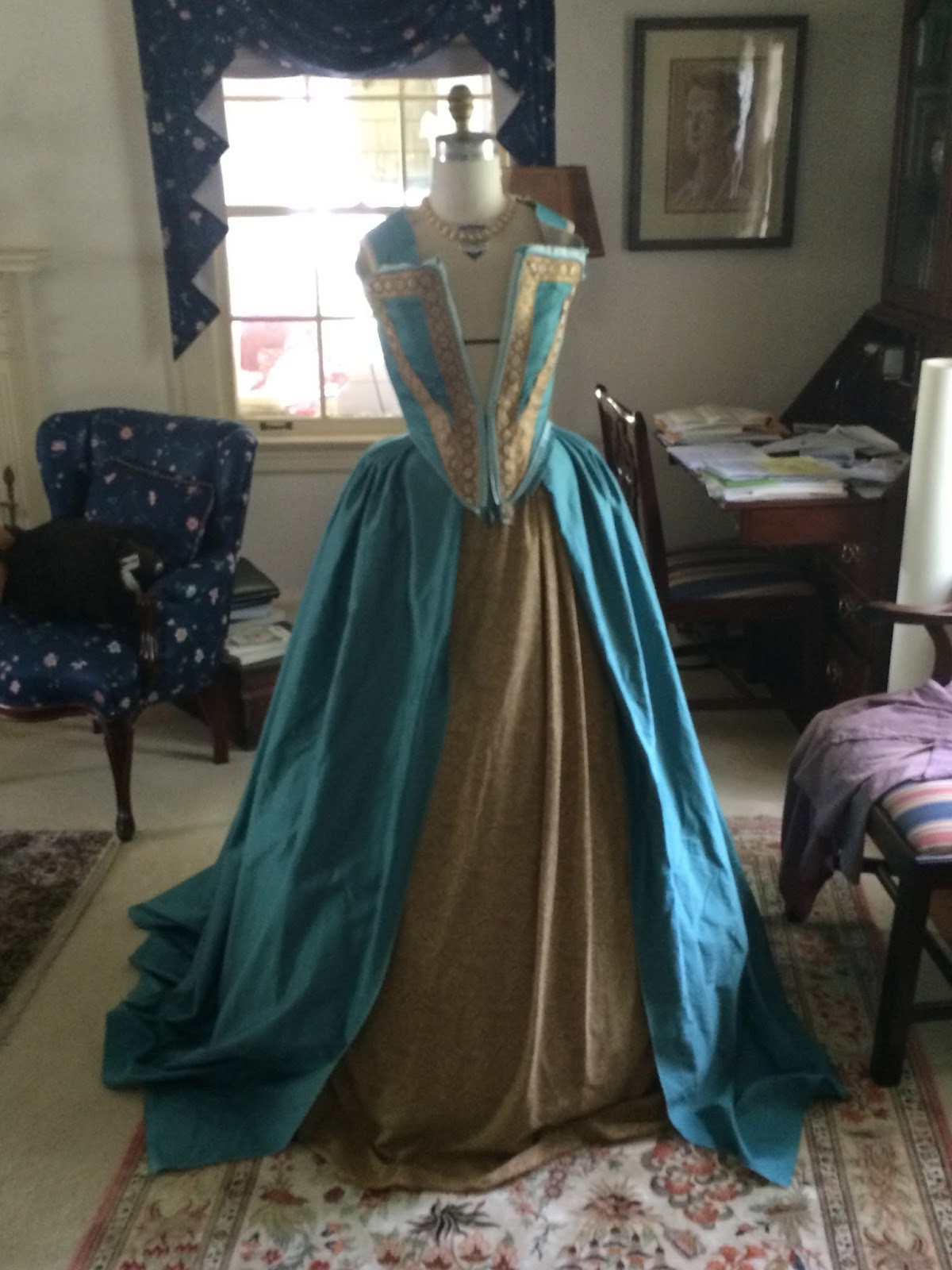
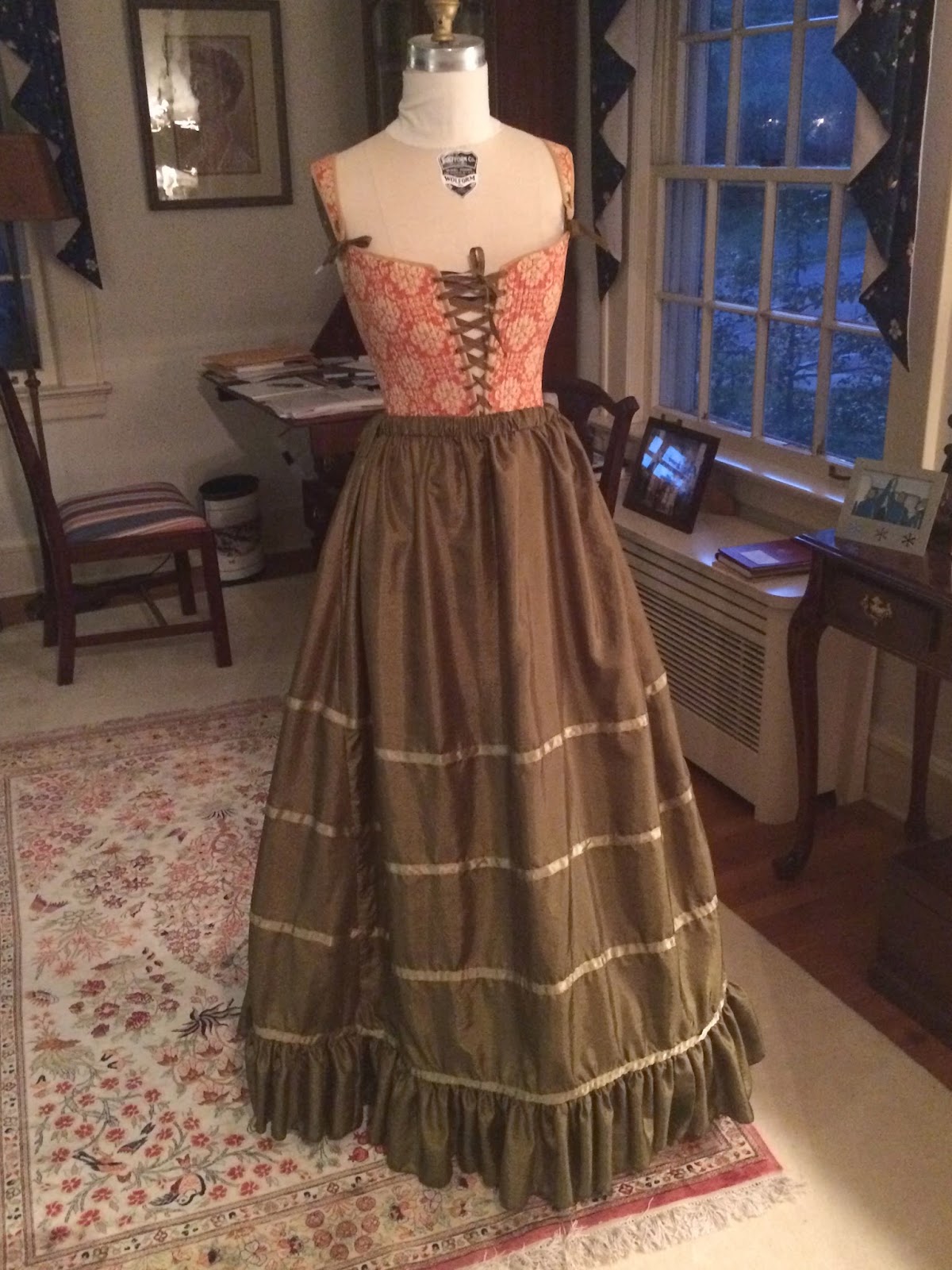
I didn't use any of the same measurements or finish my waistband the same way, but I took Alcega's example and began by creating a gored skirt, with four triangular gores attaching to rectangular front and back panels. I picked a light-weight, faux silk Polyester Nightmare (tm) fabric from JoAnn's for my farthingale because I wanted it to be 1. lightweight and 2. slippery. I've had problems before with petticoats 'catching' and sticking to my overskirts, so I wanted to make sure that my farthingale would be nice and slick and let the petticoat slide over it naturally. So far, there hasn't been a downside to this fabric choice, but we'll have to wait and see how it holds up to wear!
I chose to finish my waistband with elastic, as opposed to the more common snaps or ties, because there will already be so many bulky things around my waist (petticoat, bum-roll, overskirt) and I didn't want any more strings or stiffened waistbands to get tangled in. I wanted to make my boning channels from grosgrain ribbon, but the closest color match at Michael's was satin. So satin it is, and I hope this won't come back to haunt me.
The gored skirt on my mannequin. We were having family visit, so I dressed the form up to prove that I am actually up to something, not just making a huge mess.
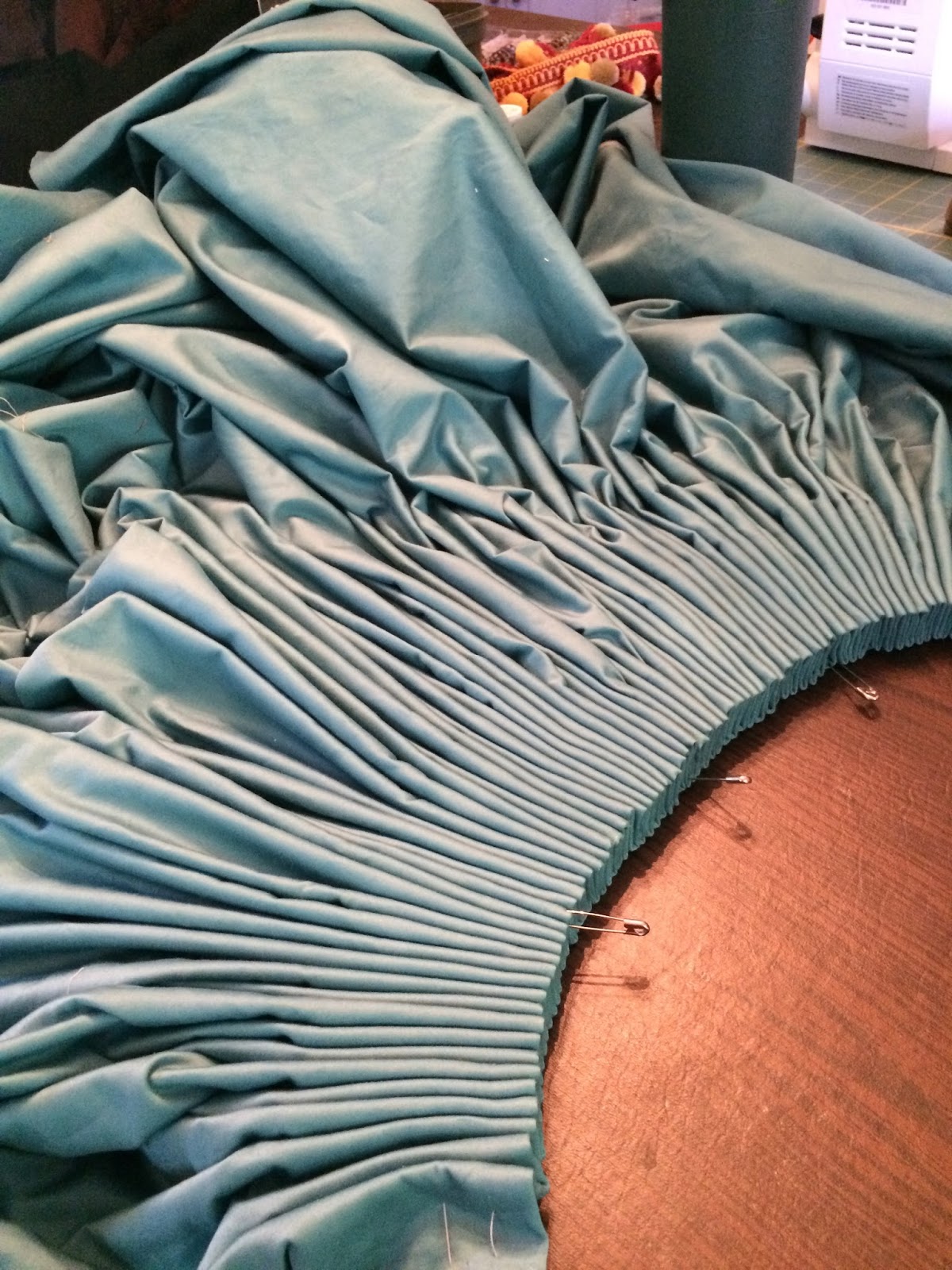
I had extra fabric, so I decided to make a ruffle! This took forever (36 yards, serged on both sides and gathered) but I am glad that I did it- I really gives the garment a more 'finished' look, and I hope the ruffle will keep the overskirts from collapsing too much below the lowest hoop. My skirt is about 3.5 yards wide at the bottom.
Poly nightmare fabric is your friend.
My boning is from corsetmakingsupplies.com and came in a 12 yard roll, which was just enough for my 4 hoops. I didn't cut it initially, because I wanted to experiment with the size of the bottom hoop.
The farthingale with one hoop, worn with my bum-roll and the moss silk petticoat. It doesn't look quite right- I think I'll be slimming down the sides of the bum-roll. I can also see the bone pushing against the petticoat and causing an ugly line, which is a big no-no.
Well, here is that portrait-appropriate flare shape, but it looks like a mess. Not quite there yet.
Progress! Here is the skirt with two boning hoops in it:
The left side is sticking out way further than the right- the is solved by sliding the hoops through the boning channels until they lie more evenly. Eventually, when I decide on a final shape, I'll tack each hoop in a few places to keep them from shifting. I also chose to stagger where the boning channels open and the hoops connect: this is so that if the hoops are weaker at their connecting spots, the whole skirt won't buckle along one line and turn into an oval or an egg-shape.
The skirt with all the channels sewn, but no hoops inserted. This thing is huge- I had fun wearing it around, pretending to know Flamenco dancing.
Four hoops! I'm leaving the channels open and unfinished for now- I want to be able to keep adjusting the size.
Four hoops, with the petticoat on top. I'm very happy with how the petticoat is falling at the hem- nice and elegant, not caving in or collapsing at all. I'm not so sure about the shape, though- it's more like a 1860's bell than a 1560's cone, but not offensively different than the portrait. I'll keep fiddling around.
I'm glad that I chose to only use 4 hoops, instead of the more usual 5-7. I can't see the channels at all under the petticoat (yes!) and it's hanging relatively naturally.
It must be the hoop skirt influencing me- while I worked on this, I began to think of my character as an Elizabethan Scarlett O'Hara. Although I haven't been officially cast, my director mentioned that one possibility would be Lettice Knollys, the Queen's cousin. Historically, she was a social climber with fairly loose morals who was very popular with the men. I imagine Lettice as flirtatious, tenacious, prone to jealousy, and a fabulous dresser- just like Scarlett! She liked to marry up and steal other people's boyfriends. In the recent BBC mini-series "Elizabeth; The Virgin Queen" Lettice even tries on the Queen's gowns and jewelry when no one is looking. A 16th century Mean Girl!